Math 073 Trig Problems


In the vein of ‘word problems can be a problem‘, I offer this worked solution to a trigonometry word problem that has stumped at least one student.

Chatham Island is located 38 kilometres N 23 degrees 17 minutes west of the community of Alert Bay. A boat in distress radios its position as N 17 degrees 35 minutes east of Chatham Island and N 18 degrees 41 minutes west of Victoria. How far is the boat from the city?

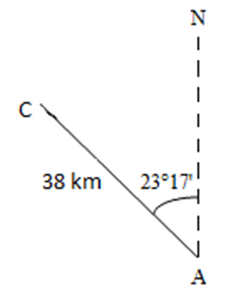
The first step is to make a drawing. We will use the letter C to represent Chatham Island, the letter A to represent Alert Bay and the letter N to represent due North.
 

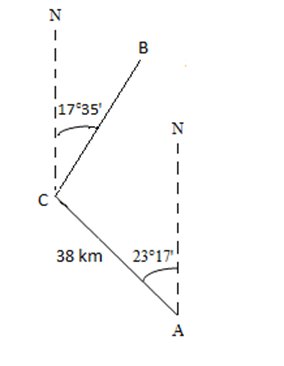
The boat is N 17 degrees 35 minutes of Chatham Island. We add it to the above drawing as B and get the following.
 

The boat’s position of N 19 degrees 41 minutes West of Alert Bay is the last bit of information we add.
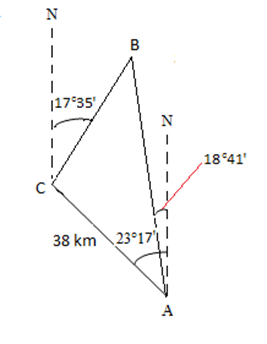


So we can easily enter numbers into the calculator, we convert all angles to decimal degrees from degrees and minutes. We need to remember that one minute is one sixtieth of a degree or 1/60. So to convert the angle above Chatham Island we multiply the 35 minutes by 1/60 and then add that to the 17 degrees to get (rounded to the nearest ten thousandth) the following:

17.5833 degrees

Using the same approach with the other angles we get

18.6833 degrees

23.2833 degrees

Now that we have everything in the drawing, let’s take stock of what we know.

Side b (across from angle B) is 38 km. Therefore b = 38.

It is important to note that, at the moment we do NOT know what angle A, B or C are. In particular note that the angle at the bottom of the drawing, 23.2833 degrees, is NOT angle A. However, we can soon calculate angle A by subtracting

23.2833 degrees from 18.6833 degrees to get 4.6000 degrees. So now we know

A = 4.6000 degrees

How about the other angles? We can find angle C, if we apply some Intermediate Math geometry. Thanks to the two parallel lines, running due north, we can use the Transversal Postulate to determine angle C. See http://library.thinkquest.org/20991/geo/parallel.html for a more detailed description of this concept of parallel lines and congruent angles. See below for how we use this concept of congruent angles to determine angle C.

For simplicity, let’s remove line a (or AB) so we can focus on line AC and the two parallel lines.
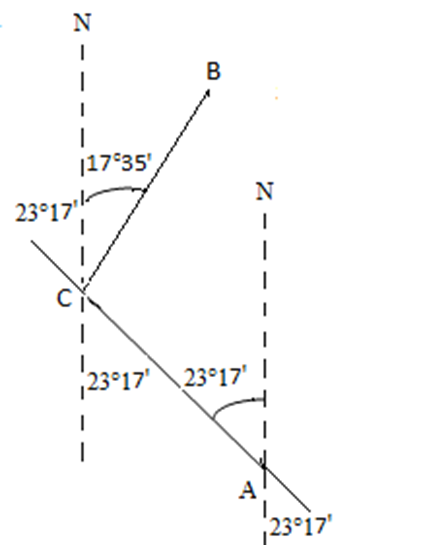
 

Now we add the given angle of 17.5833 to the determined angle of 23.2833 to get 40.8666 degrees.

17.5833 + 23.2833 = 40.8666

Remembering that a straight line has 180 degrees we can subtract 40.8666 from 180 degrees.

180 – 40.8666 = 139.1334

That tells us that angle C is 139.1334 degrees.

Also remembering that a triangle has 180 degrees, we can add angle A (4.6000 degrees) to angle C (139.1334 degrees) and then subtract that 180 degrees to find angle B.

180 – (4.6000 + 139.1334) = 36.2666

Thus angle B is 36.2666 degrees.

Let’s bring back the drawing of the original problem, now with all the angles included.
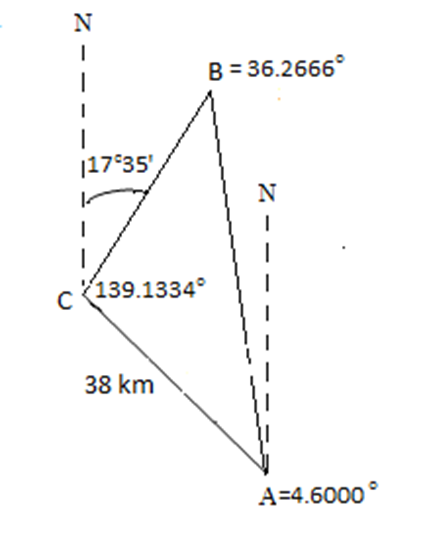
The distance the boat (B) is from Alert Bay (A) is represented by line BA (also known a line c). We use the law of sines to find c.

b/sin B = c/sin C

Substituting the appropriate values in, we have

38/sin 36.2666 = c/sin 139.1334

c = 38 x sin 139.1334/ sin 36.2666

c is approximately 42 km (rounded).

So the boat is 42 km from Alert Bay. Using the law of sins again we could also determine how far the boat is from Chatham Island.

NROC Focus Group

I was invited to be part of a focus group of 12 college educators to view and discuss developmental OER math materials being developed by National Repository of Online Courses. They are an arm of the Monterey Institute for Technology and Education.

The Gates Foundation is providing funding to them to develop developmental math materials specifically for disadvantaged students. NROC has received $5 million from Gates and $1 million from William and Flora Hewlett Foundation to develop online and hybrid materials. The goal is to increase number of financially disadvantaged students that pass developmental math. The target group are is those between 18 and 80 (average age 28) who who have failed math at least once. The project approach is to develop new educational interventions for national distribution and sustainability.

According to their website,

NROC content is distributed free-of-charge to students and teachers at public websites including HippoCampus. Institutions wishing to use NROC content are invited to join a fee-based membership organization, the NROC Network. Organizations serving disadvantaged students can become members of the NROC Network at no cost. http://www.montereyinstitute.org/nroc/nroc.html

Colleges wanting to use the materials in their LMS would need to join the NROC Network. However, we were told the materials will be freely available as standalone modules throught the hippocampus.org website.

The materials I saw demoed were in a Moodle environment, but their plan is support a number of platforms. The materials were presented in multimedia and text formats. The videos were in Flash format and plans are to include closed captioning. The latter has now been mandated for all educational videos available in the state of California and likely soon in the rest of the USA. They have also partnered with the KahnAcademy.org which has tens of thousands of video lessons available in YouTube format. The materials ranging from basic arithmetic through statistics will be released later this year and the next.

I came away favourably impressed. However, the missing piece is linkage to an assessment tool in a pre, post and unit test format that helps create ‘learnable’ moments for students. I like the way Pearson’s MathXL can make resources available to learners for each question and each concept. I don’t find the materials Pearson provides particularly helpful. The best of both worlds would be to link these kind of OER materials to an assessment tool like MathXL.

Washington’s Open Course Library

Cable Green led a round table discussion on Washington State’s initiative to lower textbook costs. What is driving this initiative? Textbook debt has surpassed credit card debt in the USA with $12 billion dollars a year spent on textbooks in the USA.

The confluence of Creative Commons licenses and the dropping price of computers is behind this initiative to share resources. There is a need for a cultural shift from ‘not invented here’ to ‘what resources can we collaborate on’. A conversation about a cultural change that encourages sharing is critical. Washington State has begun this process with their highest enrolled courses, the general ones.

All of their materials are ADA compliant, including videos. YouTube has a beta that will automatically do the closed captions that will soon be required by all states.. Anyone who receives state grants for curriculum development has to agree to a Creative Commons Attribution license. It is important to think in modules rather than complete courses.

All of the curriculum content has a Creative Commons Attribution only license and then goes into the Connexions repository hosted by Rice. Connexions is a place to view and share educational material made of small knowledge chunks called modules that can be organized as courses, books, reports, and so on. Anyone may view or contribute. Authors create and collaborate. Instructors rapidly build and share custom collections.
Learners find and explore content.

More information is available in the Washington State Strategic Technology Plan is the product of an 18-month analysis conducted by the Technology Transformation Task Force of the State Board for Community and Technical Colleges for the purpose of creating a roadmap for how our system needs to leverage 21st Century technologies to support student achievement.

See also the http://www.oercommons.org/ and http://opencourselibrary.wikispaces.com/.

Supercharge your course content with WordPress

Why WordPress?

Ease of use
Free and reliable
No partitioned content
Files can be linked from any server

Baltimore Community College uses it for video tutorials for supplementary content. They use screen capture software (Camtasia) for tutorial. Samson Go Mic for audio capture. Use H.264 for video compression. Use IMA 4:1 and mono for audio. See http://pixelrich.Wordpress.com and adimfaculty.Wordpress.com.

The Math Emporium — A Paradigm Shift in Teaching and Learning

This presentation was by folks from Madisonville Community College in Kentucky.

The problem is that performance by students in developmental math has remained unchanged for five years. Over 60% of enrolled new students needed math upgrading. However, what they were doing was not working. They decided to increase the likelihood of success by inverting the teaching and learning paradigm.

In the traditional math classroom you watch the professor do math in class and then go home to practice. Trouble is many students were practicing the wrong approach. The goal here is for the student to become an independent thinkers and not just replicate what the professor has done. In the ’emporium’ approach the students do the homework in class with the professor there to engage with them. The students watch video lectures at home. The goal is achieving and demonstrating mastery.

The schedule can be fixed, flexible or mixed. Most the two year colleges are fixed. The four year colleges are flexible or fixed. They off load faculty prep and grading to the technology so that faculty spend more time with the learner. They use Pearson’s MyMathLab for testing.

This model reminds me of the open lab we used to run in ABE at Interurban, coupled with the MathXL system I have developed and am currently using. Their mastery level is 80% They also recognize that these learners may have trouble completing a course in one term, so thy are awarded an MP or making progress grade. They then reregister for the next term. They can also move on to the next level as soon as they are finished one level.